
Podcast: Play in new window | Download
Subscribe: Spotify | Email | RSS | More
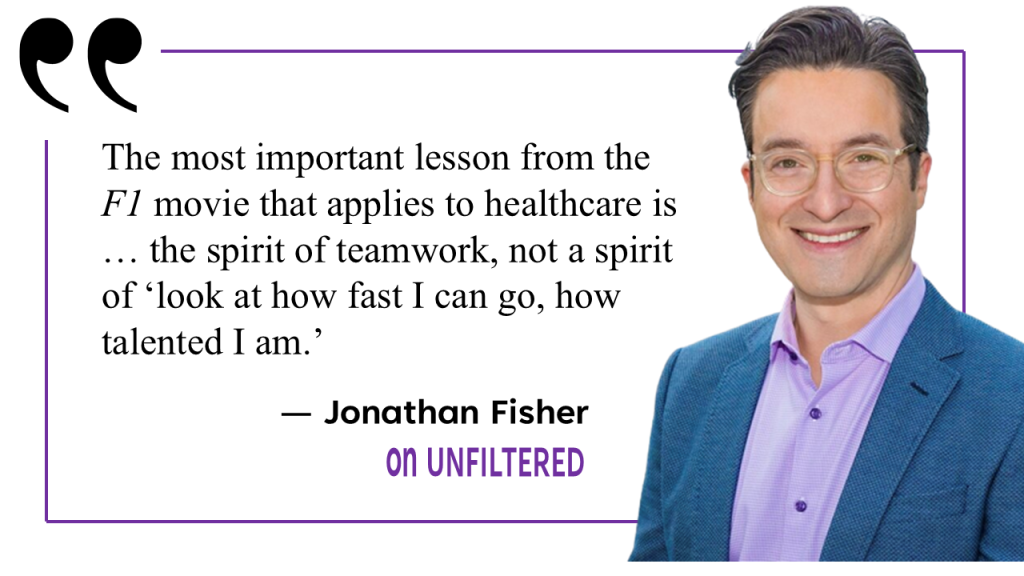
In this Unfiltered episode of Fixing Healthcare, hosts Dr. Robert Pearl and Jeremy Corr sit down with cardiologist and mindfulness expert Dr. Jonathan Fisher for a wide-ranging conversation on leadership, culture and team performance, inspired by lessons from the movie F1.
What begins as a discussion about racing quickly becomes a deep exploration of how high-performing teams operate under pressure. In the movie (and in real Formula 1 racing), success depends not on a single star driver but on flawless coordination, communication and shared accountability. The same, the trio argues, is true in healthcare where patient outcomes increasingly depend on the strength of teams, not individual brilliance.
From there, Drs. Pearl and Fisher focus on how leaders are developed, how to handle disruptive personalities, how to align departments and how physicians can prepare for long-term career success in a rapidly changing healthcare landscape that includes the rise of generative AI.
Some of the key ideas discussed:
- Healthcare is a team sport. Like an F1 pit crew, modern medical teams operate in high-stakes, time-sensitive environments. Excellence requires clarity of roles, rehearsal, debriefing and mutual trust not just individual skill.
- Leadership can be learned. Charisma helps, but effective leadership is less about personality and more about behavior. Empathy, emotional regulation and intentional communication are skills that can be developed with practice.
- Delivery often matters more than content. Fisher emphasizes the gap between what leaders intend to communicate and what their teams hear. Non-verbal cues (posture, tone, eye contact and “prosody”) often determine whether a message lands.
- Curiosity over judgment. When faced with disruptive or “toxic” behavior, leaders must stay regulated, address unacceptable actions clearly and then seek to understand the underlying drivers.
- Culture flows from leadership. If an entire department resists change, the issue often centers on the department’s leader. Alignment requires clarity of values, expectations and consequences … and sometimes difficult conversations.
- Excellence requires transparency. High-performing organizations define standards, measure outcomes and make performance visible. Coaching and incentives must align with expectations.
- Physician leaders need training not just promotion. The group discusses how brilliant clinicians are often elevated into leadership roles without preparation, and why formal leadership development is essential for healthcare’s future.
- Planning for succession matters. Pearl points out that great leaders build a “bench.” Teams should be structured to endure transitions, not collapse when one individual exits.
- The future of medicine will reward human skills. As generative AI takes on more algorithmic tasks, communication, empathy and leadership will become even more essential competencies for physicians.
Throughout the episode, Dr. Fisher reminds listeners that leadership is not about dominance or perfection. It is about presence, self-awareness and the willingness to understand how others think, feel and respond. For more unfiltered conversation, listen to the full episode and explore these related resources:
- ‘Just One Heart’ (Jonathan Fisher’s newest book)
- ‘ChatGPT, MD’ (Robert Pearl’s newest book)
- Monthly Musings on American Healthcare (Robert Pearl’s newsletter)
* * *
Fixing Healthcare is a co-production of Dr. Robert Pearl and Jeremy Corr. Subscribe to the show via Apple Podcasts or wherever you find podcasts. Join the conversation or suggest a guest by following the show on Twitter and LinkedIn.