
Podcast: Play in new window | Download
Subscribe: Spotify | Email | RSS | More
Dr. John Whyte has spent his career at the intersection of medicine, media and public policy. Now, as CEO of the American Medical Association, he hears firsthand what physicians, patients and health leaders are most concerned about and what they expect from the future of healthcare.
That perspective makes him an ideal guest for Season 11 of Fixing Healthcare with cohosts Dr. Robert Pearl and Jeremy Corr.
This season’s guests bring more than impressive résumés and large social-media followings. They bring insight into what people across the country are actually talking about: the fears they express, the questions they ask and the expectations they carry into exam rooms, boardrooms and online conversations.
Whyte has held leadership roles at the FDA and Centers for Medicare & Medicaid Services. He later became chief medical officer at WebMD and chief medical expert for Discovery Channel. In each position, he has focused on translating complex medical issues into clear, actionable information.
In this conversation, he shares what he is hearing now and why the answers will require both cultural and structural change.
Key highlights include:
- Three concerns dominate for physicians. Whyte opens by identifying what he hears most often across the country: frustration with prior authorization and payment incentives in Medicare and Medicaid, anxiety about scope-of-practice changes, and uncertainty about how physicians should lead (rather than react to) the rapid rise of digital health and generative AI.
- Medicaid disruption and impact on children. Whyte explains that policy changes at both federal and state levels could leave vulnerable populations without coverage or access to care. He emphasizes that nearly half of U.S. children rely on Medicaid.
- Payment models and physician autonomy. The discussion explores tensions between fee-for-service, Medicare Advantage and value-based approaches. Whyte argues that physicians must retain meaningful choice in how they practice and get paid, even as consolidation and employment models reduce autonomy.
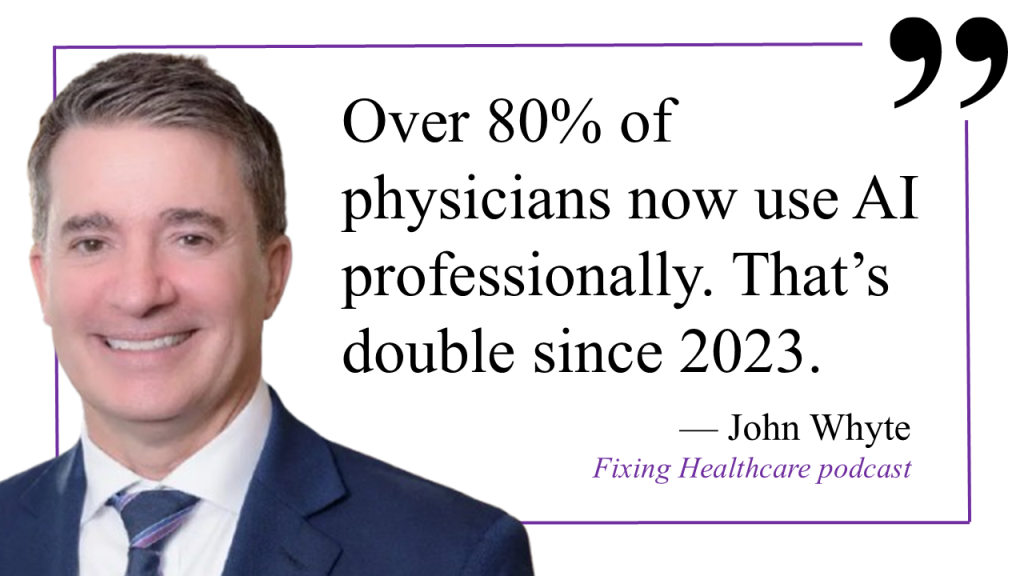
- Generative AI as “augmented intelligence.” Whyte notes that more than 80% of physicians now use AI tools professionally, largely for documentation and communication tasks. The real opportunity, he says, lies in improving diagnosis, personalization and continuous monitoring.
- Home as the future site of care. From wearables to smart diagnostic devices, Whyte envisions a shift away from episodic office visits toward continuous monitoring and preventive care.
- Outcome-based reimbursement. Pearl asks whether paying for outcomes could unlock broader adoption of AI-enabled tools. Whyte acknowledges the promise but highlights practical challenges, including patient complexity, burnout and the risk that efficiency gains could simply lead to higher patient volumes.
- The evolving physician-patient relationship in the AI era. With a growing share of patients using generative AI before appointments, Whyte encourages clinicians to view digitally informed patients as partners. Open dialogue, trusted sources and shared decision-making, he argues, will define effective care in the years ahead.
There’s so much more to this episode. Tune in to find out what physicians and patients should expect from the future of medicine.
* * *
Fixing Healthcare is a co-production of Dr. Robert Pearl and Jeremy Corr. Subscribe to the show via Apple, Spotify, Stitcher or wherever you find podcasts. Join the conversation or suggest a guest by following the show on Twitter and LinkedIn