
Podcast: Play in new window | Download
Subscribe: Spotify | Email | RSS | More
OpenAI didn’t need to convince patients to try generative AI.
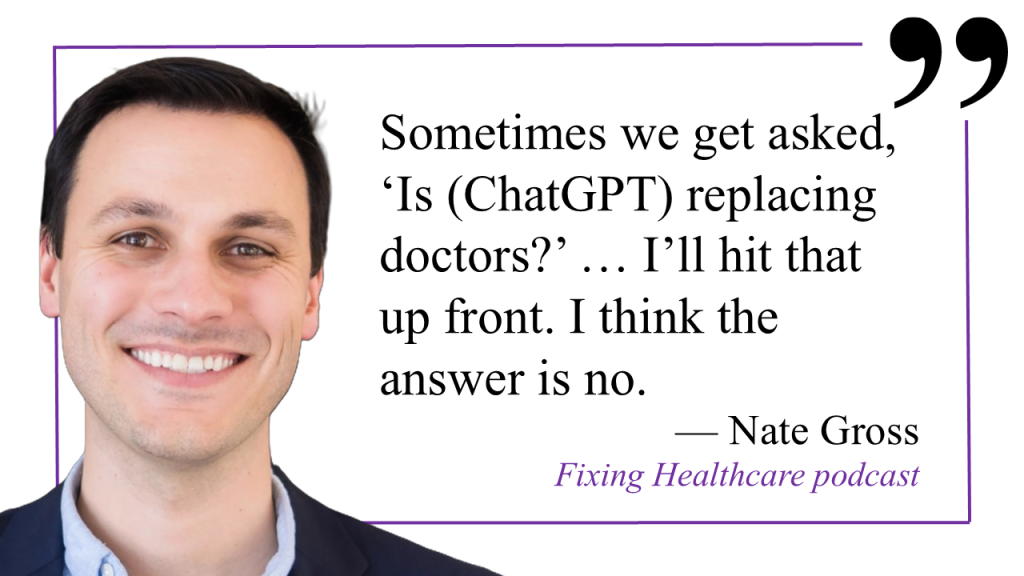
According to Dr. Nate Gross, Health of Health at OpenAI, 230 million people already use ChatGPT each week to interpret lab results, prepare for visits, understand diagnoses or ask health-related questions they didn’t have time (or confidence) to raise in the exam room.
But what about clinicians?
On this episode of Fixing Healthcare, Dr. Robert Pearl and Jeremy Corr speak with Dr. Gross, who previously co-founded Doximity and Rock Health, about OpenAI’s latest step: the release of ChatGPT for Clinicians, a new offering that brings healthcare-specific AI tools directly to individual providers, without requiring access through a large health system contract.
In other words, the same capabilities previously limited to enterprise deployments are now being placed in the hands of front-line clinicians.
But as Dr. Gross makes clear in this timely interview, the story of AI in medicine is much bigger than a single product. It’s about how generative AI is beginning to reshape healthcare across three fronts at once: patients, clinicians and health systems.
Key highlights include:
- Patients are already using AI at massive scale. Gross notes that roughly 40 million people turn to ChatGPT for help outside the clinical setting each day, often at night or between visits. They’re using it to understand symptoms, interpret medical advice and navigate a fragmented healthcare system.
- Clinicians don’t want another AI tool. They want less friction. From documentation and inbox overload to prior authorizations and evidence review, physicians are looking for ways to reduce administrative burden and focus on patient care. Generative AI, when applied well, can help “sweep the floor” of repetitive work.
- ChatGPT for clinicians expands access beyond health systems. Previously, OpenAI’s healthcare tools were deployed through enterprise environments. This new release allows individual physicians, nurses and other providers to access clinical-grade AI tools directly, regardless of where they practice.
- Healthcare is shifting from “if” to “how” with AI. Health systems are no longer debating whether generative AI is real or ready. Instead, leaders are focused on how to deploy it safely, securely and in ways that improve care without introducing new risks.
- Fragmentation remains healthcare’s biggest challenge. Patients often act as the “integration layer” between specialists, systems and settings. Gross sees AI as a potential tool to help synthesize information, coordinate care and improve communication across the system.
- The future of care extends beyond the clinic. From chronic disease management to hospital-at-home models, AI tools could help patients better understand and follow care plans in their daily lives, improving outcomes between visits, not just during them.
- Medical education and research are also evolving. Gross highlights OpenAI’s work to personalize learning for clinicians and accelerate scientific discovery, including new AI models designed to support biology, genomics and drug development.
- Skepticism still matters. Despite the momentum, Gross emphasizes the importance of validation, clinician oversight and continuous feedback to ensure these tools are used responsibly and effectively.
-
Dr. Pearl shares his thoughts. Pearl embraces Gross’s three-part framework of patients, clinicians and health systems, but believes the greatest opportunity lies in transforming how care is delivered. From chronic disease management to AI-powered care in the home, he emphasizes that the real impact will come not from administrative gains, but from improving outcomes at scale—provided healthcare moves fast enough to keep today’s challenges from becoming tomorrow’s crises.
There’s much more in this conversation, including how healthcare leaders should think about AI in long-term planning and a deeper dive into the biggest opportunities that lie ahead.
Tune in to hear what physicians, patients and health systems should expect from the next chapter of medicine.
* * *
Dr. Robert Pearl is the bestselling author of ChatGPT, MD: How AI-Empowered Patients & Doctors Can Take Back Control of American Medicine. Fixing Healthcare is a co-production of Dr. Robert Pearl and Jeremy Corr. Subscribe to the show via Apple, Spotify or wherever you find podcasts. Join the conversation or suggest a guest by following the show on X and LinkedIn.