
Podcast: Play in new window | Download
Subscribe: Spotify | Email | RSS | More
Dr. Anthony “Mazz” Mazzarelli brings a rare combination of perspectives to American healthcare: physician, executive, lawyer, bioethicist, author and media voice.
As co-president and CEO of Cooper University Health Care and associate dean of clinical affairs at Cooper Medical School, Mazzarelli leads a major safety-net health system while continuing to see patients himself. He is also co-author of Compassionomics, a book that makes the evidence-based case that compassion in medicine improves outcomes, lowers costs and reduces clinician burnout.
That combination makes him an ideal guest for Fixing Healthcare with cohosts Dr. Robert Pearl and Jeremy Corr.
This season’s guests are being asked what they are hearing from patients, clinicians and the public right now.
For Mazzarelli, three themes rise to the top:
- Growing concern over Medicaid cuts and rising uninsurance
- Excitement about generative AI and other new technologies
- Awe at the speed of change healthcare leaders will need to manage
Key episode highlights include:
- Medicaid cuts will hit safety-net patients hardest. At Cooper, roughly one-third of patients are covered by Medicaid or are self-pay. Mazzarelli explains that many of these patients live paycheck to paycheck or depend on coverage to manage chronic disease. When they lose access, prevention disappears and patients often delay care until they show up sicker in emergency departments and hospitals.
- Generative AI is a promising tool for rethinking how care is delivered. Ambient listening and automated notes are helpful, he says, but the larger opportunity lies in decision support, preventive outreach, chronic disease management, medication adherence and giving clinicians more time to connect with patients.
- Fraud prevention should not become a barrier to legitimate care. Mazzarelli supports catching fraud and abuse in Medicaid and Medicare, but argues that AI should be used to identify bad actors more precisely so the system can reduce unnecessary checkboxes.
- Employer-based healthcare has hidden the true cost crisis. Employers and government programs have absorbed much of the rising cost of care, preventing individuals from feeling the full impact. That delay has reduced pressure for major reform, even as the system becomes increasingly unaffordable.
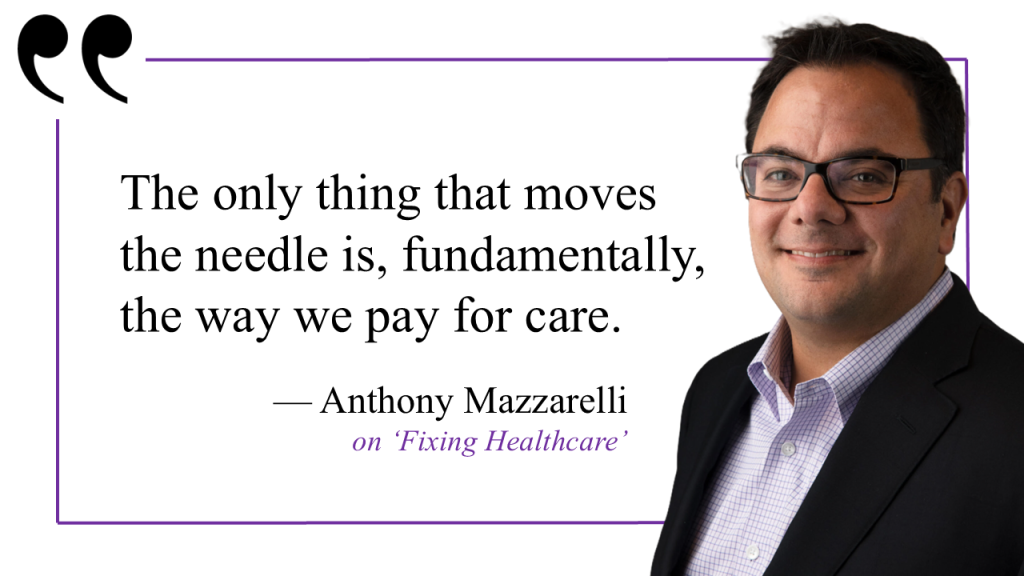
- Payment reform remains the real lever for change. While Mazzarelli supports incremental improvements, he says the biggest changes will require addressing the way care is paid for, including the misaligned incentives that shape nearly every part of American healthcare.
- AI can help clinicians reconnect with patients. Compassion is not a soft concept. Stronger patient connection has been linked to better outcomes, lower costs, fewer unnecessary tests and less burnout among clinicians.
- Technology should redesign care, not automate bad workflows. Mazzarelli cautions that healthcare does not simply need better AI models. It needs leaders willing to redesign workflows in an “AI-native” way rather than layering technology on top of broken processes.
- Convenience must be balanced with human connection. Jeremy raises concerns about the broader health consequences of modern convenience, including loneliness and isolation. Mazzarelli agrees, noting that loneliness is a major public health risk and that healthcare organizations have a responsibility to address it.
- Burnout requires more than wellness programs. Mazzarelli argues that yoga, walks and wellness initiatives are not enough if clinicians feel disconnected from the work itself. The real antidote, he says, is restoring meaning at the point of care by helping clinicians connect with patients and see the difference they make.
There’s much more in this conversation, including Cooper’s co-president model, the impact of private equity on physician practice, the future of 24/7 access and how policymakers should think about AI safety without slowing progress.
Tune in to hear what one of healthcare’s most thoughtful physician-executives believes patients, clinicians and leaders should expect from the next era of medicine.
* * *
Dr. Robert Pearl is the author of “ChatGPT, MD: How AI-Empowered Patients & Doctors Can Take Back Control of American Medicine.” Fixing Healthcare is a co-production of Dr. Robert Pearl and Jeremy Corr. Subscribe to the show via Apple, Spotify or wherever you find podcasts. Join the conversation or suggest a guest by following the show on X and LinkedIn.