
Podcast: Play in new window | Download
Subscribe: Spotify | Email | RSS | More
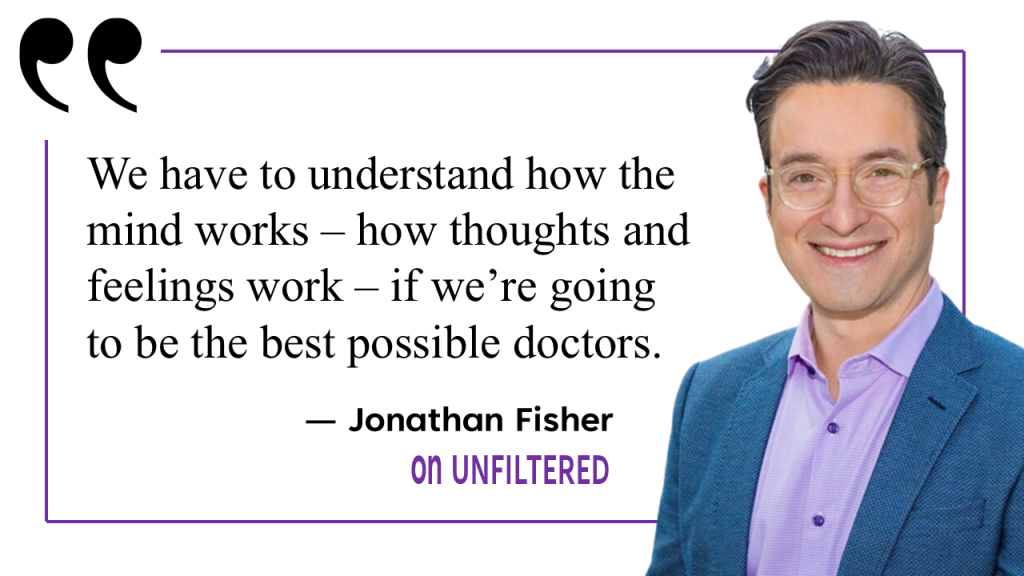
In this Unfiltered episode of Fixing Healthcare, Drs. Robert Pearl and Jonathan Fisher join cohost Jeremy Corr for a fascinating conversation about the physician’s mind, the promise and limits of generative AI, and what medicine risks losing when technology advances faster than humans can tolerate.
In this episode, Pearl turns to a realization he had during a recent hiking trip in Portugal: his brain felt different while walking through the woods than it does while solving analytical problems.
That observation leads to a deeper discussion of “left brain” and “right brain” thinking in medicine. Fisher explains that while the popular labels are oversimplified, the underlying challenge is real. Doctors must integrate structured reasoning with emotional awareness, diagnosis with relationship, and technical expertise with the human experience of illness.
The discussion then moves into one of the episode’s most provocative questions: Can generative AI be taught to express empathy and relational intelligence as well as humans? Pearl points to studies showing that AI-generated responses to patient questions can be rated as highly empathetic, comprehensive and accurate. Fisher pushes back, arguing that there is a difference between perceived empathy in written answers and the embodied presence of a physician sitting with a fearful patient and family in a vulnerable moment.
What follows is a thoughtful disagreement about the future of medicine. Pearl sees generative AI as a way to fill dangerous gaps in American healthcare, including lack of access after hours, rural shortages, diagnostic errors, preventable medical mistakes and poorly controlled chronic disease. Fisher worries that if AI begins taking over both analytical and relational parts of care, physicians may feel even more threatened in a profession already marked by burnout and uncertainty.
This leads to the debate’s central question: Will generative AI become the enslaver of clinicians or the liberator? Pearl argues that AI could help physicians escape the growing corporatization of medicine by taking on routine work, expanding access and enabling doctors to practice with more autonomy. Fisher agrees that this future is possible but cautions that in a fee-for-service system, efficiency gains may simply become an excuse to increase volume, billing and pressure on clinicians.
Finally, Jeremy brings the conversation back to everyday life by asking whether heavy reliance on technology and AI could weaken the mind the same way physical inactivity weakens the body. Fisher warns that when people offload too much thinking, emotion and relationship-building to devices, they risk losing cognitive sharpness and emotional attunement. Pearl agrees that every technology carries benefits and harms, arguing that the goal should be balance: using AI to learn, understand and solve problems without letting it flatten life’s richer, more meaningful experiences.
For more unfiltered conversation, listen to the full episode and explore these related resources:
- ‘Just One Heart’ (Jonathan Fisher’s newest book)
- ‘ChatGPT, MD’ (Robert Pearl’s newest book)
- Monthly Musings on American Healthcare (Robert Pearl’s newsletter)
* * *
Fixing Healthcare is a co-production of Dr. Robert Pearl and Jeremy Corr. Subscribe to the show via Apple Podcasts or wherever you find podcasts. Join the conversation or suggest a guest by following the show on Twitter and LinkedIn.