
Podcast: Play in new window | Download
Subscribe: Spotify | Email | RSS | More
In this week’s episode of Medicine: The Truth, hosts Jeremy Corr and Dr. Robert Pearl dig for the facts beneath healthcare’s biggest headlines. Today’s show opens with the issue most likely to shape how Americans think about healthcare heading into the midterm elections: affordability.
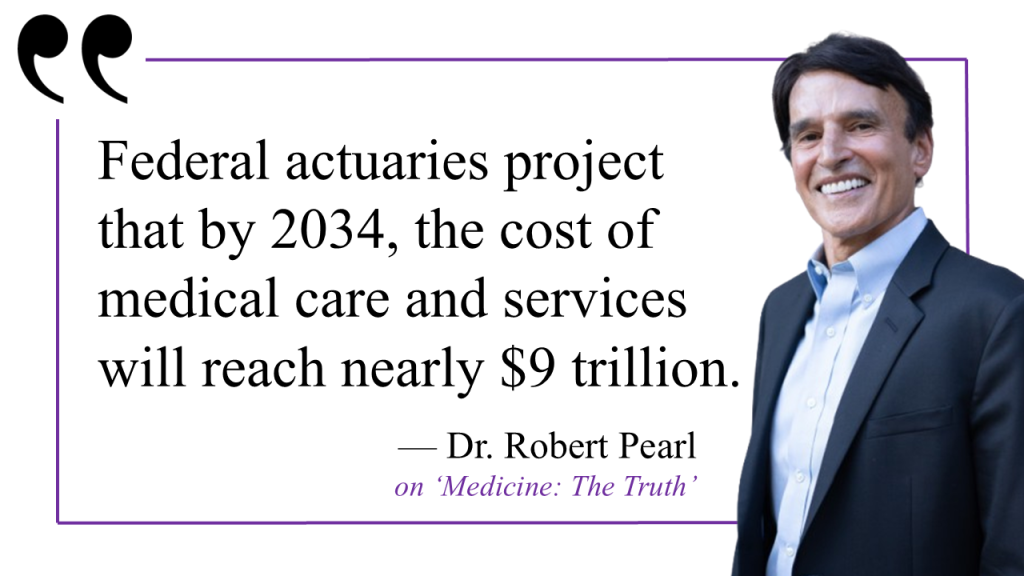
Dr. Pearl explains that medical costs have now reached $5.7 trillion, rising more than 7% for the third consecutive year. Federal actuaries project that healthcare spending could approach $9 trillion by 2034, accounting for more than 20% of the U.S. GDP. For voters, employers, patients and families, those numbers aren’t just an endless string of zeroes. They’re impacting everyday life.
Premiums, deductibles, copays and prescription drug costs are forcing people with private insurance, Medicare and exchange coverage to delay care, take on debt or choose worse coverage. Two major drivers stand out: hospital spending and drug costs. Hospital care remains the largest share of national healthcare expenses, while drug spending is rising fastest, driven in part by the growing use of GLP-1 medications. Pearl sees enormous potential in these drugs to improve health and reduce complications over time, but only if prices fall low enough for the long-term savings to justify the near-term expense.
That tension becomes clearer in the discussion of Medicare’s new GLP-1 pilot program for weight loss. Under the “bridge program,” eligible Medicare enrollees will be able to obtain GLP-1 medications for $50 a month, far below current retail prices. Pearl calls the program an important experiment, but also notes its limitations: coverage is not automatic, eligibility is restricted, administrative hurdles remain and the pilot may end after 18 months. If patients lose access and regain weight, the program could fail despite the promise of the medication.
The episode then moves into several unusual and important stories, including new research into the origins of life, the medical risks of cannibalism, the promise and limitations of wearable health data, a large cyclosporiasis outbreak, rising e-bike injuries among children and adolescents, a new cholesterol-lowering pill, CDC leadership and measles.
Here are the major storylines from episode 109:
- Researchers studying the origin of life made progress by taking a counterintuitive approach: building a synthetic cell from simple inorganic materials rather than stripping existing life forms down to their minimum parts.
- “Spud cell” research could eventually help scientists understand which genes are essential and create engineered cells capable of producing new medical treatments.
- A new study suggests cannibalism may have disappeared in part because of medical consequences, including infections and prion diseases that harmed tribes practicing it.
- Wearable devices are generating valuable health data, but most doctors lack the time, reimbursement and regulatory pathways needed to integrate that information into clinical care.
- A large cyclosporiasis outbreak has raised concerns about foodborne illness surveillance, produce safety and the difficulty of identifying contamination sources when symptoms appear one to two weeks after exposure.
- E-bike injuries are rising, especially among children and adolescents, with head, face and neck injuries posing particular concern.
- The FDA has approved a new pill that can lower LDL cholesterol to very low levels, though Pearl emphasizes that most average-risk patients should still rely on low-cost generic statins.
- The nomination hearing for Dr. Erica Schwartz as CDC director highlighted the continuing tension between science and politics, especially around vaccines, RFK Jr. and public trust in federal health agencies.
- Measles cases continue to rise, with nearly all occurring among unvaccinated people and with serious risks for those whose immunity has waned.
- Generative AI may reduce costs and accelerate parts of drug development, but no AI-generated medication has yet obtained FDA approval.
The episode closes with a broader reflection on Season 11 of Fixing Healthcare. Pearl notes that the concerns raised by guests with large public followings are often different from the priorities emphasized by clinicians and national medical societies. Most Americans are not asking for unreasonable things. They want healthcare that is easier to access, affordable for their families and personalized to their circumstances. That gap, Pearl argues, may change how patients use technology. Large language models such as ChatGPT, Claude and Gemini are available 24/7, provide information at no additional cost and become more personalized as patients share more details. While many doctors worry that hospitals or insurers will replace them with AI, Pearl sees a different threat emerging: patients at home, frustrated by delays, high costs and feeling unheard, turning to generative AI because the healthcare system has not met their needs.
Tune in to hear the full discussion and subscribe to Medicine: The Truth for more fact-based analysis of the medical, scientific and policy stories shaping American healthcare.
* * *
Dr. Robert Pearl is the author of “ChatGPT, MD: How AI-Empowered Patients & Doctors Can Take Back Control of American Medicine” about the impact of AI on the future of medicine.
Fixing Healthcare is a co-production of Dr. Robert Pearl and Jeremy Corr. Subscribe to the show via Apple, Spotify or wherever you find podcasts. Join the conversation or suggest a guest by following the show on X and LinkedIn.