
Podcast: Play in new window | Download
Subscribe: Spotify | Email | RSS | More
Season 11 of Fixing Healthcare continues its shift away from the traditional top-down model of interviewing CEOs, policymakers and medical leaders to focus this week on something new, different and fascinating: listening to the generation that is inheriting this American healthcare system.
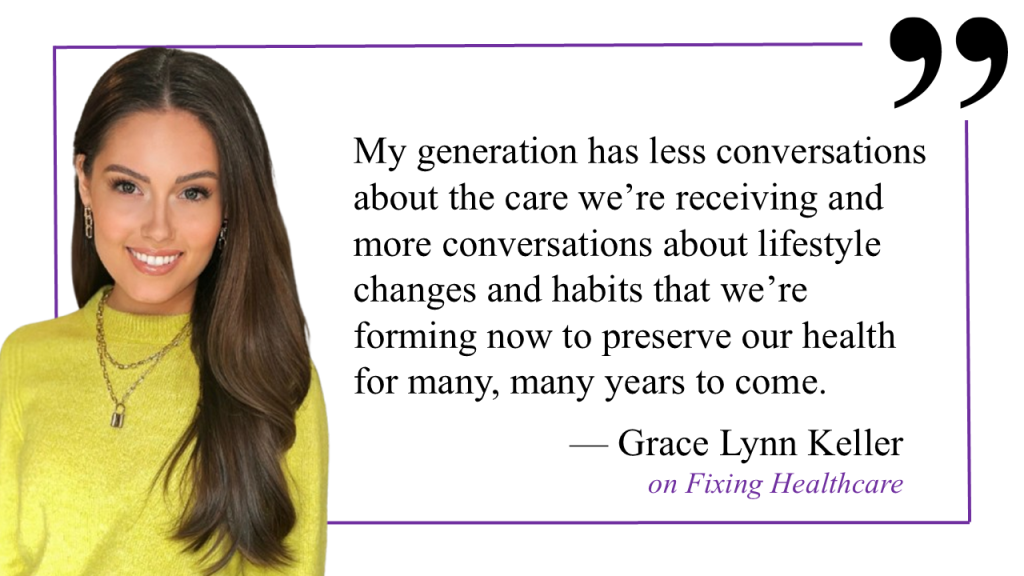
In this episode, Dr. Robert Pearl and Jeremy Corr speak with Grace Lynn Keller, VP at Executive Podcast Solutions, former Miss America contestant and the show’s first-ever Gen Z guest.
Grace brings a rare vantage point: Professionally, she is immersed in conversations with healthcare executives. Personally, she is part of the generation that consumes health information through social media, wearables and AI tools. For healthcare professionals, the conversation offers an important lens on how Gen Z gathers health information, how they decide when to seek care and what they expect from clinicians, insurers and government leaders.
One insight stood out immediately. When asked where she would turn first with a non-emergency symptom, Grace answered without hesitation: ChatGPT.
Her answer signals how much the healthcare landscape is changing. While Gen Z may turn to generative AI for initial medical advice, that is only one piece of a broader shift. In this conversation, Grace outlines how her generation is redefining health, prevention and trust. Key insights include:
- Verification Over Blind Trust. Gen Z does not simply accept what it reads online. Grace describes a culture of cross-referencing, double-checking and comparing sources across platforms before acting.
- Prevention As Identity. Her generation emphasizes whole foods, ingredient awareness and minimizing processed products. Health is considered a long-term lifestyle investment rather than reactive medical intervention.
- Wearables As Standard Equipment. Smart watches and rings are commonplace. Continuous data on sleep, movement, heart rate and hormonal cycles shape daily decisions and reinforce prevention.
- Convenience And Cost Sensitivity. Time away from work, co-pays and scheduling delays influence care decisions. If reliable AI-based treatment were available for routine conditions, many Gen Zers would use it immediately.
- Mental Health As Mainstream. Therapy is normalized. Work-life balance is considered protective, not indulgent. “Mental health days” may frustrate older generations but are viewed as necessary boundaries by younger workers.
- Skepticism Of Bureaucracy. Insurance complexity is a major frustration. Deductibles, out-of-pocket maximums and opaque pricing create confusion for first-time independent users.
- Demand For Transparency. Grace compares healthcare to e-commerce: if nearly every other industry offers clear pricing and frictionless purchasing, why not medicine?
- Alcohol And Cultural Moderation. Among her peers, alcohol consumption is more situational and less habitual. Health-conscious decision-making extends beyond diet and exercise.
- Education Gaps. Public school health education was limited largely to sex ed and anti-drug messaging. She sees schools as the only scalable venue to improve health literacy nationwide.
There’s so much more to this episode. Tune in to find out what the next generation of patients expects from doctors, nurses and healthcare leaders.
Helpful links
- “From TikTok to Telehealth: 3 Ways Medicine Must Evolve to Reach Gen Z” (Fulcrum)
- “Why younger patients turn away from doctors & toward GenAI” (Fixing Healthcare podcast)
- “Healthcare Regulators’ Outdated Thinking Will Cost American Lives” (Forbes)
- “ChatGPT, MD: How AI-Empowered Doctors and Patients Can Take Back Control of American Medicine” (Pearl’s newest book)
* * *
Fixing Healthcare is a co-production of Dr. Robert Pearl and Jeremy Corr. Subscribe to the show via Apple, Spotify, Stitcher or wherever you find podcasts. Join the conversation or suggest a guest by following the show on Twitter and LinkedIn.