
Podcast: Play in new window | Download
Subscribe: Spotify | Email | RSS | More
In this Diving Deep episode, Dr. Robert Pearl and Jeremy Corr examine the rapid advance of generative AI, along with the growing conflict between medicine’s mission to heal and doctors’ need for financial security.
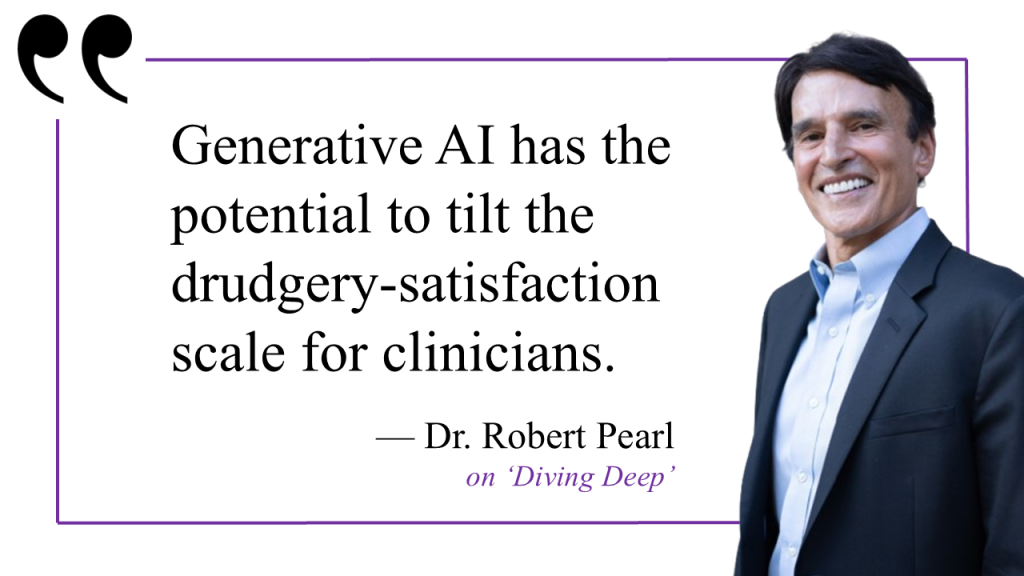
The conversation begins with a question now echoing across every profession: Will AI replace highly trained workers? In medicine, Dr. Pearl argues, the answer is less about replacement than redefinition. Drawing on recent changes in software development, he explains how “vibe coding” has allowed programmers to stop writing much of the code themselves and instead use generative AI to build, test and refine applications from plain-language instructions. Rather than feeling diminished, many coders report greater satisfaction because AI has taken over the repetitive, error-prone work and left them more time for problem-solving.
Pearl sees a similar possibility in healthcare. Like coding, medicine relies on years of training, structured reasoning and repeatable processes. Chronic disease management offers the clearest example. Hypertension, diabetes and high cholesterol are leading causes of heart attacks, strokes and kidney failure, yet proven treatments often fail because doctors lack the time to monitor patients continuously and adjust medications quickly. With home devices, physician-set targets and generative AI support, care could shift from occasional office visits to ongoing management, helping more patients achieve control while freeing physicians to focus on complex cases.
The second half of the episode turns from technology to mission. Using Tim Cook’s legacy at Apple as a case study, Pearl examines what happens when values and financial incentives collide. Cook’s tenure produced extraordinary business results, but critics have questioned whether some of his choices conflicted with his own values and Apple’s public statements around privacy, dignity and human-centered technology.
Pearl uses that as background for a similar question about medicine: What happens when doctors, who train to help and heal others above all else, feel increasingly forced to make career decisions shaped by money?
For generations, medicine was understood as a calling. Today, most physicians no longer own their practices. Many now work for hospitals, health systems, insurers or private equity-backed groups, while others have moved into concierge or direct primary care models. Pearl stresses that these choices are rational.
But the financial upside comes with psychological and moral consequences that are rarely discussed — and that may shape the future of physician fulfillment.
For more, tune into this month’s episode and check out the links below.
Helpful links
- The AI Revolution In Coding Offers A Preview Of Medicine’s Future (Forbes)
- What Tim Cook’s Legacy Teaches Doctors About Money And Mission (Forbes)
- Monthly Musings on American Healthcare (RobertPearlMD.com)
* * *
Dr. Robert Pearl is the author of “ChatGPT, MD: How AI-Empowered Patients & Doctors Can Take Back Control of American Medicine.” Fixing Healthcare is a co-production of Dr. Robert Pearl and Jeremy Corr. Subscribe to the show via Apple, Spotify or wherever you find podcasts. Join the conversation or suggest a guest by following the show on X and LinkedIn.