
Podcast: Play in new window | Download
Subscribe: Spotify | Email | RSS | More
In this Diving Deep episode, Dr. Robert Pearl and Jeremy Corr examine two big questions facing American medicine: how generative AI can make healthcare more affordable and what the World Cup can teach doctors about strategy, teamwork and leadership.
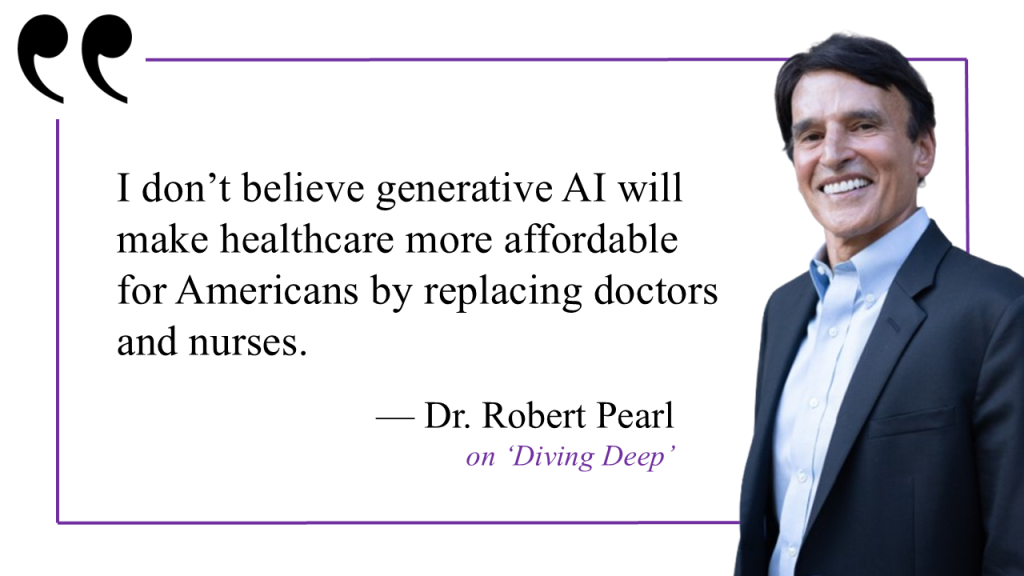
The conversation begins with a counterintuitive point: In other industries, technology often lowers costs by allowing companies to produce the same output with fewer workers. But Dr. Pearl knows medicine is different. In healthcare, the biggest costs arise when preventable and controllable conditions turn into life-threatening complications. Therefore, he does not believe GenAI’s greatest financial value in healthcare will come from replacing doctors and nurses.
Pearl argues that the surest way to lower healthcare spending is by keeping people healthier. Poorly controlled hypertension, diabetes, heart failure and kidney disease drive many of the nation’s most expensive complications, including heart attacks, strokes, kidney failure, hospitalizations and surgeries. GenAI can help prevent those outcomes, and the savings could far exceed anything gained by reducing clinician headcount.
From there, Pearl identifies three major opportunities for GenAI-driven improvements:
- Control chronic diseases by helping patients understand their conditions, track data from home devices and get medication adjustments sooner (rather than waiting months between office visits).
- Expand access to medical expertise after hours and on weekends.
- Improve care coordination and medication safety, especially for older adults with multiple chronic conditions.
But technology alone will not be enough. So, the second half of the episode turns to entrepreneurship and leadership. Pearl discusses new research comparing expensive physician-facing AI tools with general-purpose large language models such as ChatGPT, Claude and Gemini.
His takeaway for entrepreneurs is clear: the biggest opportunity may not be building costly tools for hospitals, but helping patients use the AI tools already available on their computers and smartphones to manage their health more effectively.
That point leads into a broader lesson from the recent World Cup. Pearl argues that American medicine, like many talented teams that failed to win soccer’s biggest prize, has extraordinary resources but lacks a shared strategy. The United States has exceptional doctors, world-class hospitals and more healthcare spending than any nation, yet outcomes remain inconsistent, access unreliable and costs unaffordable.
The episode closes with a warning and a challenge. American medicine already has the talent, technology and financial resources to succeed. What it lacks is a clear strategy, coordinated teamwork and effective clinician leadership. If doctors want to improve care for patients and preserve the profession’s values, Pearl argues, they will need to embrace new technology, work together differently and take responsibility for the system’s performance.
For more, tune into this month’s episode and check out the links below.
Helpful links:
- Entrepreneurs Beware: Inexpensive AI Is The Future Of Medicine (Forbes)
- GenAI Won’t Lower Medical Costs By Replacing Doctors And Nurses (Forbes)
- 47 World Cup Teams Fell Short. US Medicine Should Learn From Them (Forbes)
- Monthly Musings on American Healthcare (RobertPearlMD.com)
* * *
Dr. Robert Pearl is the author of ChatGPT, MD: How AI-Empowered Patients & Doctors Can Take Back Control of American Medicine.
Fixing Healthcare is a co-production of Dr. Robert Pearl and Jeremy Corr. Subscribe to the show via Apple, Spotify or wherever you find podcasts. Join the conversation or suggest a guest by following the show on X and LinkedIn.