
Podcast: Play in new window | Download
Subscribe: Spotify | Email | RSS | More
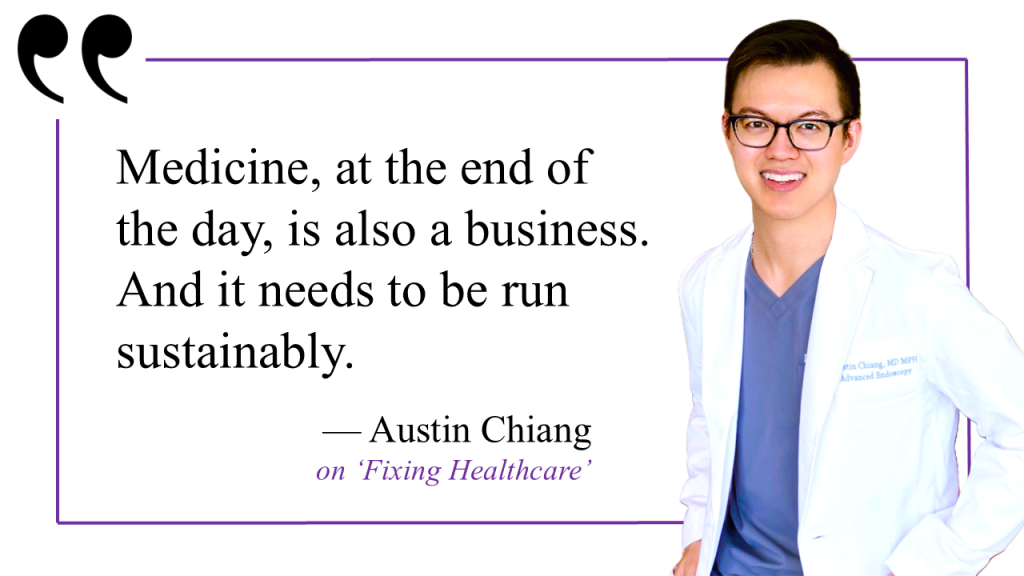
Dr. Austin Chiang has built one of medicine’s most distinctive public platforms.
He is a triple board-certified gastroenterologist, Chief Medical Officer for Medtronic’s Endoscopy business and Associate Professor of Medicine at Thomas Jefferson University. He is also one of healthcare’s most influential physician voices online, with hundreds of thousands of followers across TikTok, Instagram, YouTube and LinkedIn.
That makes him an ideal guest for Season 11 of Fixing Healthcare with cohosts Dr. Robert Pearl and Jeremy Corr. This season asks what patients, clinicians and healthcare leaders are saying now that feels meaningfully different from the past.
Chiang hears those concerns from several vantage points: as a practicing physician, medical technology leader, educator and public-facing doctor.
For Chiang, three issues stand out:
Clinician burnout and loss of autonomy
Chiang says physicians are struggling with administrative burden, documentation demands, prior authorization, staffing shortages, reimbursement pressure and a growing sense that medical decisions are no longer fully in their hands. Pearl pushes further, asking whether clinicians must take more responsibility for affordability rather than simply objecting to the oversight created in response to rising costs. Chiang agrees that physicians need a better understanding of the broader healthcare ecosystem if they want to help change it.
Medical misinformation and social media
Chiang has spent more than a decade learning how to communicate across platforms and audiences. He explains that accurate medical information must now compete with sensationalized claims from people who are not held to the same professional standards as clinicians. For doctors, the challenge is to be credible without being boring, engaging without becoming irresponsible and platform-specific without compromising the message. That tension is especially important in areas like gut health, diet, probiotics and the microbiome, where uncertainty creates space for simple but potentially misleading answers.
Clinician-led innovation
As Medtronic’s Chief Medical Officer for Endoscopy, Chiang works at the intersection of clinical practice and medical technology. He explains that innovation in medicine is slow for good reason: new tools must prove safety, clinical value, workflow fit and real-world usefulness before becoming mainstream. But he argues that clinicians need to be more involved in that process because they understand the nuances of patient care, staff experience and adoption better than outsiders can.
The conversation also explores colorectal cancer, which is rising among younger adults. Chiang explains why colonoscopy remains the gold standard for prevention, while also noting that lowering screening ages further would create major capacity challenges. He also discusses AI-assisted polyp detection, the future of endoscopy and why fully autonomous colonoscopy remains difficult given the complexity of human anatomy.
There’s much more in this conversation, including physician career paths beyond traditional practice, how doctors should respond when patients bring AI-generated information to appointments and what people with chronic GI conditions need from clinicians, platforms and online communities.
Tune in to hear one of medicine’s most visible digital physician leaders explain how doctors can help shape a future where technology, social media and medical innovation better serve patients.
* * *
Fixing Healthcare is a co-production of Dr. Robert Pearl and Jeremy Corr. Subscribe to the show via Apple, Spotify, Stitcher or wherever you find podcasts. Join the conversation or suggest a guest by following the show on X and LinkedIn.