
Podcast: Play in new window | Download
Subscribe: Spotify | Email | RSS | More
In this week’s episode of Medicine: The Truth, hosts Jeremy Corr and Dr. Robert Pearl go in search of the facts beneath healthcare’s biggest headlines. Today’s show opens with one of the hottest and least understood medical topics: experimental peptides.
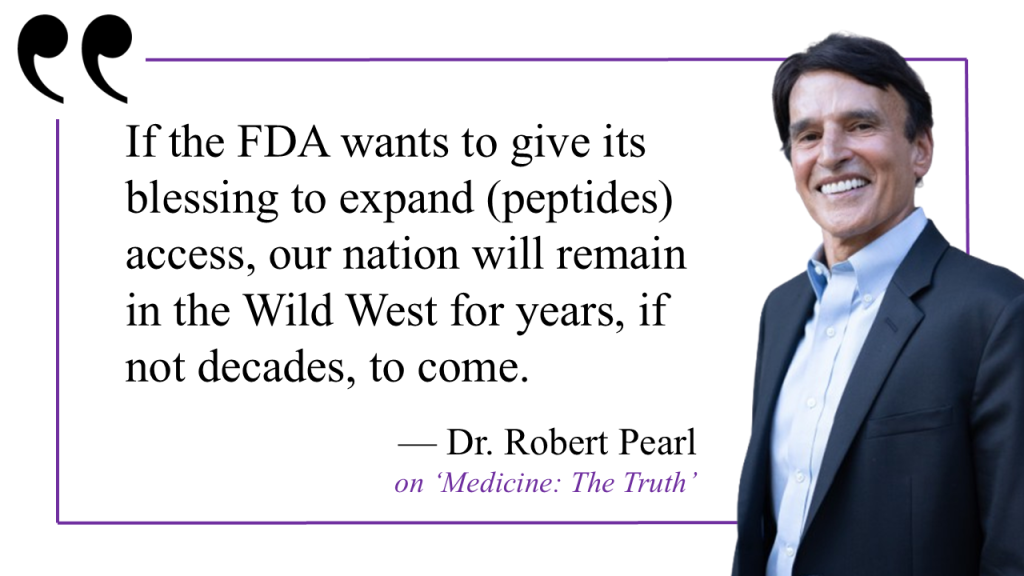
Pearl explains that an FDA advisory committee narrowly recommended allowing compounding pharmacies to provide six experimental peptides to patients. This is not the same as traditional FDA approval. Rather than reviewing a drug through the usual three-phase clinical trial process, the recommendation would allow suppliers to provide peptide ingredients that compounding pharmacies could use to fill prescriptions.
Pearl then explains why this distinction matters. If the FDA follows the committee’s recommendation, many patients may assume the peptides have been vetted like other approved medications. He warns that this could leave the nation in a medical gray zone, with broad access but little rigorous evidence on safety, effectiveness, dosing or long-term risk.
The episode then turns to several follow-up stories and new medical developments, including the cyclospora outbreak, CDC leadership, pediatric e-bike injuries, AI-designed viruses, Ebola, mRNA flu vaccines and the continuing politicization of vaccine policy:
- The cyclospora outbreak appears to be slowing, but the total case count remains high and the exact source has not been fully confirmed.
- Erica Schwartz has been confirmed as CDC director, becoming the agency’s first full-time leader in a year. Pearl says Schwartz has strong credentials but will face major challenges, including depleted agency staffing, infectious disease outbreaks and political pressure around vaccines.
- Pediatric e-scooter and e-bike injuries surpassed 2,000 incidents from 2020 to 2024, according to data from Johns Hopkins researchers. Pearl warns that more states may need to restrict use among young children.
- AI can design viruses that do not currently exist in nature, a new Stanford study showed. This opens possibilities for new treatments but also raising biosecurity concerns. Pearl says the technology could one day help fight antibiotic-resistant bacterial infections, but it also raises concerns about bad actors.
- Ebola is spreading rapidly in the Democratic Republic of Congo, with more than 1,500 deaths and a mortality rate estimated at 40% to 50%.
- The FDA approved the first mRNA flu vaccine, developed by Moderna, for adults 50 and older. Pearl explains that mRNA technology could improve flu vaccination by allowing scientists to update vaccines closer to the arrival of each year’s viral strain.
The episode closes with Pearl’s strongest warning: medical decisions made on politics rather than science lead to harm. He points to President Trump’s executive order changing childhood vaccine recommendations and encouraging separation of the MMR vaccine into individual measles, mumps and rubella shots.
Pearl says there is no scientific evidence supporting the president’s claim that the combined MMR vaccine may be dangerous, while numerous studies show it is safe, effective and lifesaving. His conclusion: when scientific evidence is overwhelming, leaders need a compelling scientific reason to deviate from it. Whether the subject is experimental peptides, AI-designed viruses, mRNA vaccines or childhood immunization, medicine cannot protect patients if politics replaces data.
Tune in to hear the full discussion and subscribe to Medicine: The Truth for more fact-based analysis of the medical, scientific and policy stories shaping American healthcare.
* * *
Dr. Robert Pearl is the author of “ChatGPT, MD: How AI-Empowered Patients & Doctors Can Take Back Control of American Medicine” about the impact of AI on the future of medicine.
Fixing Healthcare is a co-production of Dr. Robert Pearl and Jeremy Corr. Subscribe to the show via Apple, Spotify or wherever you find podcasts. Join the conversation or suggest a guest by following the show on X and LinkedIn.