
Podcast: Play in new window | Download
Subscribe: Spotify | Email | RSS | More
In this episode of Fixing Healthcare, Dr. Robert Pearl and Jeremy Corr welcome back Dr. Rod Rohrich, an internationally recognized plastic surgeon, former editor-in-chief of Plastic and Reconstructive Surgery and national leader in the application and safety of social media for medical advancement.
Dr. Rohrich, a returning guest (FHC #57), focuses now on the healthcare concerns most affecting Americans today. Drawing on his experience with patients, physicians and a massive social media audience, Rohrich identifies three questions he hears most often:
- Can I trust my doctor?
- Is this information true or merely popular?
- And can AI really help me understand my health and make it better?
These questions frame a conversation about generative AI, patient empowerment, medical misinformation, physician compassion and the future of clinical practice.
Can I trust my doctor?
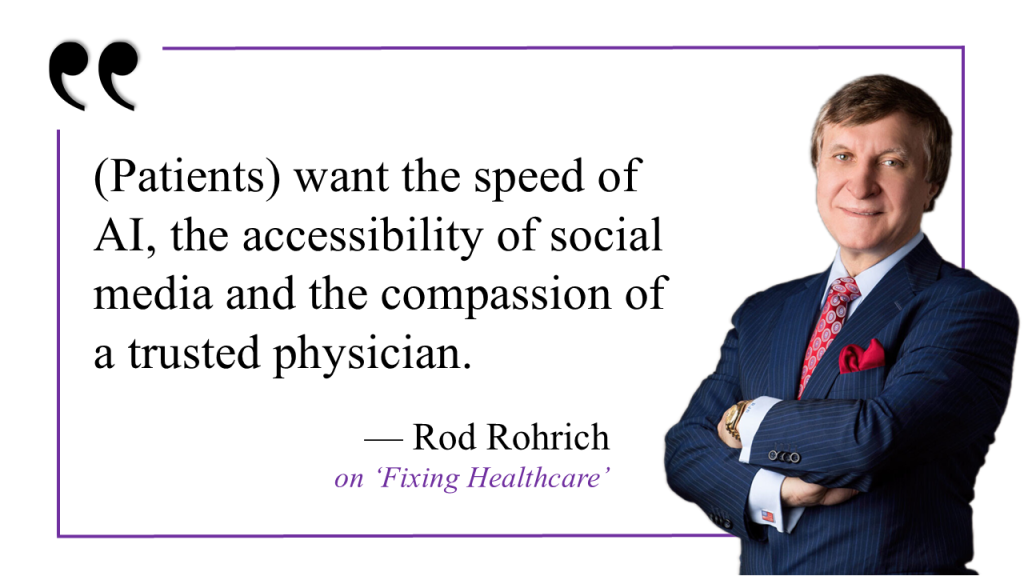
Rohrich says patients want the speed of AI and the accessibility of social media, but they still want the compassion and judgment of a trusted physician. He and Pearl agree that AI will not replace doctors, but it can help patients ask better questions, understand their conditions more quickly and arrive at appointments better prepared. Rohrich sees this already in plastic surgery, where patients bring questions, research and even AI-generated summaries into consultations. Used well, he says, AI can streamline the visit, clarify patient goals and help physicians focus faster on what the patient needs.
Is this information true or merely popular?
Rohrich’s social media experience gives him a clear view of the problem. Patients are bombarded with claims about longevity, sleep, fitness, supplements and medical treatments, often from influencers with no healthcare background. His practical advice is to use generative AI as a filter: ask tools like ChatGPT or Claude to evaluate claims based on peer-reviewed, evidence-based research and supporting references. Pearl connects the point to peptides, noting that enthusiasm is not the same as evidence. Both physicians argue that patients need better ways to distinguish science from marketing.
Can AI really help me understand my health and make it better?
Pearl and Rohrich see AI’s greatest promise in making care faster, more personalized and more humane. Rohrich shares how AI helped identify a postoperative infection from a patient photo and generate clearer instructions for home care. He also describes using AI to write more empathetic responses to anxious patients. Pearl adds that ambient AI tools can free doctors from computer screens, while future applications could help patients understand hospital care, test results and next steps. The goal, both agree, is not to remove humanity from medicine but to use technology to restore it.
Jeremy closes the show with a patient-centered concern: What happens when people receive lab, MRI or CT results through an online portal late at night, without a physician available to explain them? Rohrich says AI is already better than Google at providing context, but it must be used carefully because partial information can produce partial answers. Pearl argues that the answer is not to fear the technology, but to make secure, private AI tools more complete, accurate and useful for patients.
The episode ends with Drs. Pearl and Rohrich laying out a shared vision. Generative AI should not replace physicians. It should take work off their plates so they can focus on what only people can do: solve complex problems, communicate compassion and guide patients through frightening moments. For Rohrich and Pearl, AI offers a chance to make medicine faster, smarter and more human, but only if doctors and patients learn to use it well and keep evidence at the center.
* * *
Fixing Healthcare is a co-production of Dr. Robert Pearl and Jeremy Corr. Subscribe to the show via Apple, Spotify, Stitcher or wherever you find podcasts. Join the conversation or suggest a guest by following the show on X and LinkedIn.