
Podcast: Play in new window | Download
Subscribe: Spotify | Email | RSS | More
In this week’s episode of Medicine: The Truth, hosts Jeremy Corr and Dr. Robert Pearl probe the facts beneath healthcare’s biggest headlines. Today’s show examines the accelerating progress of generative AI, the political turmoil inside America’s leading health agencies and the infectious disease threats testing the nation’s public health readiness.
The conversation opens with a listener question about how close generative AI is to matching clinicians. Dr. Pearl explains that the technology is advancing faster than he predicted in ChatGPT, MD, with recent research showing an OpenAI model outperforming experienced physicians on emergency room triage and management in text-based clinical cases. He cautions that medicine is more complicated than written scenarios but argues that the trajectory is clear: before today’s incoming medical students finish training, generative AI tools are likely to be used in emergency rooms across the country
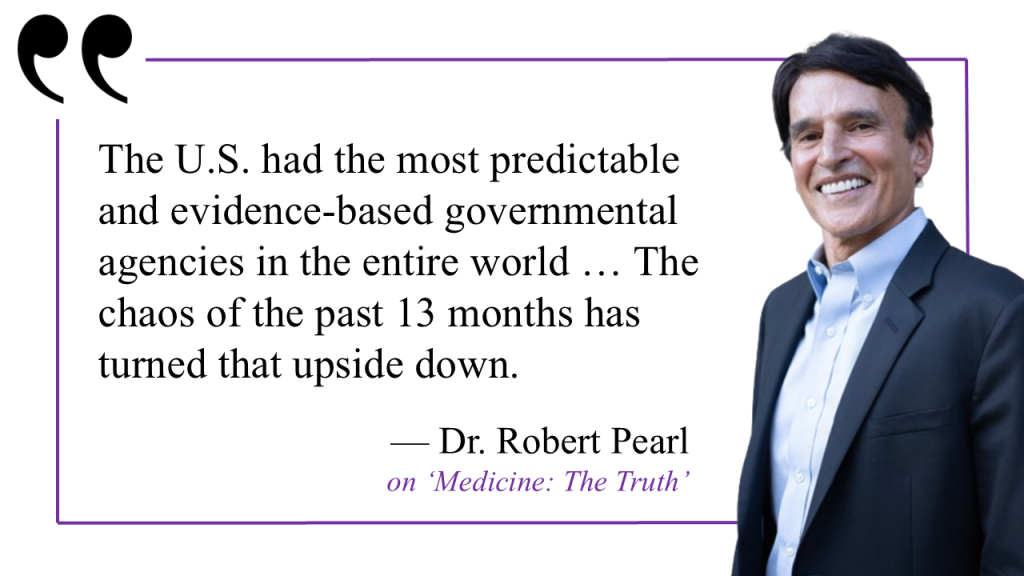
From there, the episode turns to the resignation of former FDA commissioner and Dr. Marty Makary, a two-time Fixing Healthcare guest. Pearl describes Makary as a respected clinician and patient-safety expert who found himself caught between scientific rigor, political pressure, industry opposition and public health critics. His departure, along with other leadership upheaval at FDA, CDC, NIH and HHS, raises a larger concern about whether America’s once-trusted scientific agencies can regain their independence and credibility.
Here are the other major storylines from episode 107:
- RFK Jr. removes preventive-care leaders. Pearl criticizes the firing of two respected co-chairs of the U.S. Preventive Services Task Force, warning that prevention policy may be pushed away from scientific evidence.
- The surgeon general nomination moving toward confirmation. Nicole Safier appears more confirmable than Dr. Casey Means because her vaccine views are closer to the scientific mainstream.
- A hantavirus outbreak raises public health concerns. A cruise ship outbreak involving the Andes virus appears to have spread person-to-person, causing at least 13 cases, several severe illnesses and three deaths.
- The U.S. remains vulnerable to fast-moving outbreaks. Pearl says the slow federal response to hantavirus shows how weakened public health capacity could become dangerous if a highly lethal virus were also easily transmissible.
- Tick bites are rising sharply. ER visits related to tick bites have climbed well above typical levels, driven in part by warmer temperatures and the spread of deer ticks into the Midwest and South.
- Ebola exposes the cost of global health cuts. A new Ebola strain in the Democratic Republic of Congo has no vaccine or effective treatment, and the outbreak was recognized only after spreading for weeks.
- USAID and WHO cuts increase risk to Americans. Pearl argues that reducing global public health support does not put “America first” because viruses ignore national borders.
- Patients should be more concerned when doctors avoid AI entirely. Pearl says he would worry more about clinicians who refuse to use reliable generative AI tools than those who consult them regularly.
- Opioid overdose deaths are falling but remain devastating. New CDC data show overdose deaths down for the third straight year, but annual fatalities still total roughly 70,000, with overdoses remaining the leading cause of death among adults ages 18 to 44.
- Vaccine safety data are being suppressed. Pearl closes by describing blocked FDA and CDC research showing COVID and shingles vaccines to be safe and effective, warning that political censorship undermines trust and harms patients.
Tune in for more fact-based analysis and practical perspective on the healthcare policies, technologies and trends shaping medicine today.
* * *
Dr. Robert Pearl is the author of “ChatGPT, MD: How AI-Empowered Patients & Doctors Can Take Back Control of American Medicine” about the impact of AI on the future of medicine.
Fixing Healthcare is a co-production of Dr. Robert Pearl and Jeremy Corr. Subscribe to the show via Apple, Spotify or wherever you find podcasts. Join the conversation or suggest a guest by following the show on X and LinkedIn.